Do You Need an ANSUL Fire Suppression System in Your Commercial Kitchen?
A commercial kitchen is one of the highest-risk environments in any restaurant, hotel, pub, takeaway, school, care home or catering facility. Hot oil, accumulated grease, cooking equipment, ventilation systems, gas, electricity and a busy working environment create conditions in which a fire can start and spread very quickly.
That is why relying solely on a portable fire extinguisher is not always enough. Fire extinguishers remain an essential part of fire safety, but they depend on someone noticing the fire, acting safely and using the equipment correctly. In a kitchen fire involving deep fryers, grills or grease ducts, those few seconds make all the difference.
This is where an ANSUL fire suppression system can be a vital solution for protecting people, property and business continuity.
What Is an ANSUL System?
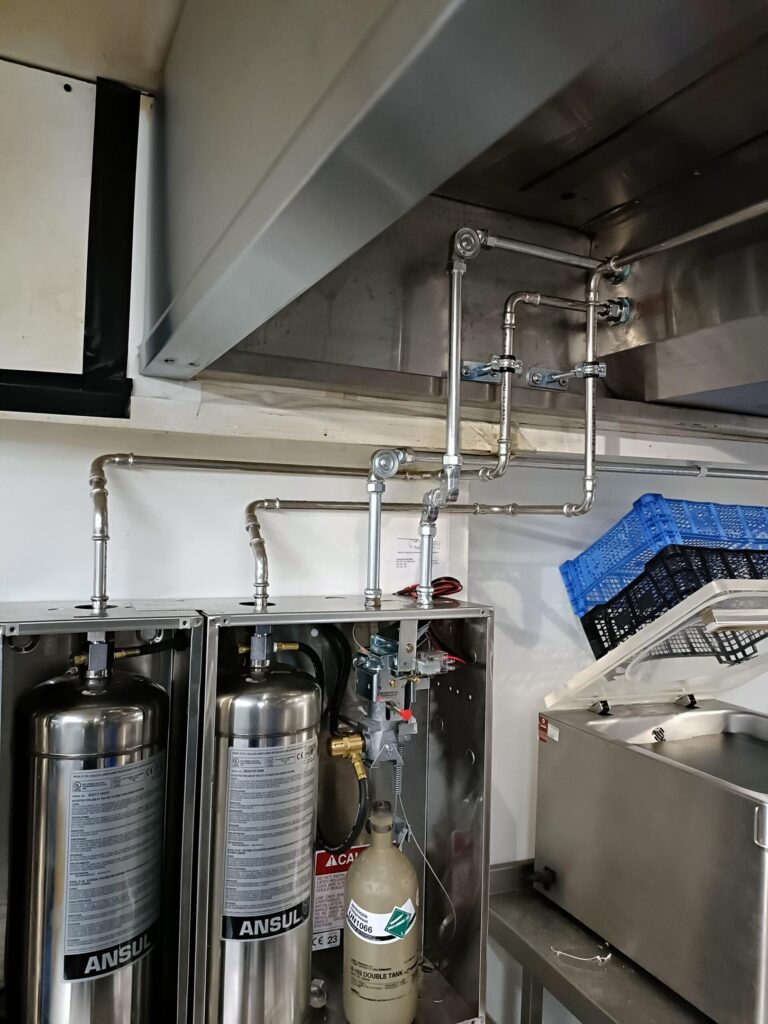
An ANSUL system is a fixed, automatic, pre-engineered fire suppression system specifically designed for fire risks in commercial kitchens. The best-known version for this type of environment is the ANSUL R-102 Restaurant Fire Suppression System, developed to protect cooking equipment, kitchen appliances, hoods, ducts, plenums, filters and areas where grease vapours can accumulate.
Across the fire protection industry, ANSUL systems are widely recognised as pre-engineered automatic solutions for demanding kitchen applications, especially where grease, hot oil and high-temperature cooking equipment create a serious fire risk.
Unlike a manual fire extinguisher, the system is permanently installed above the highest-risk areas. This low pH extinguishing system uses ANSULEX Low pH Liquid Agent, a wet chemical agent stored in dedicated agent tanks, to help knock down flames, cool hot surfaces and create a protective blanket over burning grease. This reaction helps reduce the risk of re-ignition, i.e. the fire reigniting after it has apparently been brought under control.
The ANSUL system acts as an automatic line of defence. It does not replace all other fire protection measures, but complements the safety plan with a rapid and targeted response to fires in kitchen equipment.
How Does an ANSUL Fire Suppression System Work?
The system is designed in accordance with the actual layout of the commercial kitchen, tailored to the appliances, canopy and duct arrangement, and suited to appliance-specific protection in kitchen applications. During the installation process, engineers assess the positioning of fryers, grills, hobs, cookers and ovens, as well as the canopy, ducts and ventilating equipment.
Once the design is finalised, discharge pipework and targeted spray nozzles are positioned to protect the relevant cooking appliances, hoods, plenums and ductwork. Heat-sensitive detection lines and fusible links are installed in key risk areas, with nozzle caps helping to prevent grease from blocking the outlets. When the system detects a predetermined critical temperature, the activation mechanisms trigger the release of the suppression agent automatically.
Upon activation, the ANSUL fire suppression system discharges the chemical agent onto the fire and the protected equipment. In many cases, it can also mechanically or electrically shut off the gas or electrical supply to protected cooking equipment, stopping the fuel or power feeding the fire. The system may also include a manual pull station, allowing staff to trigger the suppression in the event of a fire.
The wet chemical agent reacts with hot cooking oils and fats to form a protective blanket, helping to smother the fire, cool the cooking equipment and reduce the risk of re-ignition.
This type of response is particularly important because fires involving oil and grease do not behave like ordinary small fires. They can grow rapidly, reach filters and ducts, spread smoke and compromise the safety of the building even before the emergency services arrive.
Do You Need Fire Suppression Systems in Your Commercial Kitchen?
The answer depends on the specific risks associated with your operation. In the UK, fire safety in the workplace must be based on a proper fire risk assessment. This involves assessing the actual risks at the premises, identifying who might be affected, implementing protective measures, and ensuring these measures are maintained in good working order.
For a commercial kitchen, certain signs indicate that a fixed fire suppression system should be seriously considered:
- You use deep fryers, grills, chargrills, hobs, woks, ovens or other high-temperature cooking appliances.
- The cooking area produces grease vapours, uses mechanical extraction, has ducts or operates for long periods with a high volume of food preparation. In larger or higher-risk cooking areas, portable fire extinguishers alone may not provide adequate cover.
If your operation fits this scenario, kitchen fires can escalate extremely quickly, which is why many restaurant fire suppression systems are designed to act before staff can respond manually. An automatic suppression system has been specifically designed to act while the fire is still at its point of origin, before it spreads to the extraction system, other appliances or occupied areas of the building.
It is also common for insurers, landlords, fire risk assessment consultants or local authorities to recommend additional fire protection measures when the kitchen risk is high. In many cases, installing an ANSUL system is not just a technical decision, but a way of demonstrating responsibility, reducing risk exposure and safeguarding business continuity.
ANSUL System or Fire Extinguisher: What is the Difference?
A fire extinguisher is essential in any fire safety plan, but it is a manual measure. This means that someone needs to be present, trained, close enough to the source of the fire and safe to intervene. In a kitchen fire, this is not always a realistic scenario.
The ANSUL system, on the other hand, is automatic. It has been designed specifically for commercial kitchens and acts directly at the points where the risk is greatest. This makes it particularly suitable for restaurants, hotels, cafés, takeaways, food halls, schools, hospitals, care homes and other facilities where the kitchen is essential to day-to-day operations.
A good fire protection plan combines suitable fire extinguishers, training, alarms, electrical and mechanical maintenance, grease extraction cleaning, emergency procedures and a fixed fire suppression system where the risk assessment indicates this is necessary.
Fire Protection in the UK: What to Consider Before Installation
Before installing any ANSUL fire suppression system, it is essential to begin with a thorough site assessment. The solution must be tailored to the exact kitchen layout, taking into account the type of kitchen equipment, ventilation, fuels used, staff routines and any planned changes. Depending on the setup, the design may use appliance-specific protection, overlapping protection or a combination of both. This also helps control cost by avoiding over- or under-specification.
It is also important to work with experienced engineers. A poorly sized system, with nozzles in incorrect positions or lacking proper maintenance, may fail to provide the expected protection when it is needed. Installation should include design, assembly, commissioning, documentation and basic staff training. The process should only be considered complete once the system has been tested, commissioned and checked against the approved design requirements.
A suppression system is not just a product mounted on the wall; it is a safety system that must function correctly in a real-world fire emergency.
Maintenance and Servicing of the ANSUL System
Once installed, the system requires periodic maintenance, and ongoing servicing is essential for long-term reliability. Commercial kitchens change frequently. An appliance is replaced, a deep-fat fryer is moved, the canopy is altered or the volume of operations increases. Any of these changes can affect the system’s coverage.
Maintenance helps to verify that detection lines remain responsive, that nozzles are clear and correctly aimed, that cylinders and activation mechanisms are in good condition, and that integration with gas, electricity or alarms continues to function.
This process must be carried out by competent engineers, following the manufacturer’s recommendations, the system configuration and the results of the fire risk assessment. Many businesses rely on routine servicing, typically at six-month intervals or in line with the manufacturer’s recommendations, kitchen usage and fire risk assessment findings, to keep the system effective. Maintenance also creates important records for audits, insurers and internal safety reviews.
Why Choose LJM Fire?
Choosing the right partner is just as important as choosing the right system. LJM Fire is a trusted partner for businesses operating commercial kitchens and other high-risk facilities, delivering reliable, practical fire protection solutions tailored to the building’s actual risk profile.
For a commercial kitchen, this means assessing more than just the size of the space. It is essential to understand how the kitchen operates, which appliances are used, where grease accumulates, how the ventilation system works, and what fire safety measures are already in place.
LJM Fire can support the entire process, from the initial assessment through to installation, servicing and ongoing maintenance, using approved ANSUL systems and Tyco fire protection products where relevant to the project. With a professional and safety-focused approach, the company helps UK businesses protect people, property and operations against one of the most serious risks in commercial environments: kitchen fires.
For advice on installation, servicing or ongoing support for your commercial kitchen, contact LJM Fire.
Summary
If your commercial kitchen uses high-risk cooking equipment, grease, hot oil and extraction systems, an ANSUL fire suppression system can be an essential fire protection measure. It offers automatic activation, rapid response and targeted protection for cooking equipment, hoods, ducts and associated extraction areas.
The decision should always be based on a competent fire risk assessment, but for many restaurants, hotels, takeaways and commercial premises, the ANSUL system is a smart choice for reducing risks, supporting compliance and safeguarding business continuity.
Frequently asked questions
What is an ANSUL system?
An ANSUL system is a fixed, automatic fire suppression system. ANSUL systems are widely used across the fire protection industry for commercial kitchen applications, helping to protect cooking appliances, hoods, ducts, and areas at risk of grease or oil fires.
Do I legally need an ANSUL fire suppression system in my commercial kitchen?
There is no one-size-fits-all answer for all businesses. In the UK, the requirement depends on the fire risk assessment, the type of operation, the level of risk, and any requirements from insurers, landlords, or the relevant authorities.
Does an ANSUL system replace a fire extinguisher?
Fire extinguishers remain important, but an ANSUL fire suppression system offers automatic and targeted protection. Ideally, both should form part of a comprehensive fire safety strategy. A wet chemical fire extinguisher, such as an ANSUL K-GUARD extinguisher where suitable, may still form part of the wider fire protection plan for kitchen fire risks.
How often should an ANSUL system be serviced?
The frequency depends on the system, the kitchen’s usage, and the applicable recommendations. In general, kitchen fire suppression systems should be inspected and maintained regularly by qualified engineers, often at six-month intervals or in line with the manufacturer’s guidance and the fire risk assessment.
Can an ANSUL system protect ducts and hoods?
The ANSUL R-102 Restaurant Fire Suppression System is designed specifically to protect cooking equipment, hoods, ducts, plenums, filters, and areas associated with ventilation and grease extraction.
Enquiry

Let’s talk or fill in our enquiry form today
Have you found what your looking for? Or simply require more information? Don’t hesitate to get in touch today or fill in our enquiry form and we can arrange a call back.
Get in touch