What Are The Fire Damper Testing Requirements UK
Fire damper testing requirements help responsible persons confirm that dampers within ventilation ductwork can close as intended. In England and Wales, the legal duty is to maintain relevant fire precautions in an efficient state, in efficient working order and in good repair. The commonly followed annual testing interval comes from British Standards guidance rather than a date written directly into the legislation.
This guide explains how the law, BS 9999 fire damper testing guidance and a building’s fire risk assessment work together. It also covers inspection frequency, drop tests, access, reporting and the action needed when a damper fails.
Why fire damper testing matters
Fire dampers are passive fire protection devices fitted where ventilation ductwork passes through fire-resisting walls, floors or other compartment boundaries. Their purpose is to close the duct opening when activated, helping the compartment resist the spread of fire.
A damper may look satisfactory from outside the duct yet fail to close because of debris, corrosion, damage, an obstructed blade or a defective release mechanism. Regular fire damper inspections therefore need to include a functional test, not only a visual check.
Fire and smoke dampers are not all operated in the same way. Some fire dampers use a fusible link or thermal element, while motorised smoke-control or combination dampers may be connected to detection and control systems. The inspection and test method should suit the damper type, its manufacturer’s instructions and the building’s fire strategy.
Fire dampers play an important part in the wider fire safety systems that protect building occupants. They work with compartment walls, doors and other fire protection systems to limit the spread of fire and smoke. Regular fire damper testing gives building owners evidence about current operation, while maintenance addresses the conditions that could prevent properly functioning fire dampers from closing when required.
The legal requirements for fire damper testing
Article 17 of the Regulatory Reform (Fire Safety) Order 2005 requires fire precautions to be subject to a suitable system of maintenance and kept in efficient working order and good repair. The duty applies to the responsible person for premises covered by the Order.
The legislation does not state that every fire damper must be tested on a particular calendar date. The responsible person must instead arrange an appropriate maintenance system, informed by the fire risk assessment and relevant technical guidance. The government’s guide for people with duties under fire safety legislation explains the responsible person’s wider duties.
A fire damper test supports this maintenance duty, but a passing result does not by itself prove that every fire safety obligation has been met. Access, records, repair of defects, compartmentation and the suitability of the wider fire strategy must also be considered.
BS 9999 fire damper testing guidance
BS 9999:2017 is a code of practice for fire safety in the design, management and use of buildings. It recommends that fire dampers are tested by a competent person at intervals not exceeding one year and that spring-operated fire dampers are tested annually, with testing more frequent where conditions make this appropriate.
This is why annual testing is normally used as the baseline when setting a fire damper inspection frequency. The building’s fire risk assessment, previous findings, manufacturer’s instructions and environmental conditions may justify a shorter interval.
The British Standard is guidance rather than legislation. Following it can help demonstrate a reasonable maintenance approach, but the responsible person must ensure that the arrangements are suitable for the particular premises.
How often should fire dampers be tested?
For most premises, plan testing at intervals no greater than 12 months. A competent fire safety professional should consider whether more frequent testing is needed where dampers are exposed to:
- high levels of dust, grease or airborne debris;
- moisture, corrosion or vibration;
- repeated faults or previous failed tests;
- changes to ductwork, compartmentation or building use;
- manufacturer-specific servicing requirements.
The answer to “how often should fire dampers be tested” should therefore be recorded as part of a risk-based maintenance programme. Annual testing is the usual starting point, while the actual schedule should reflect the building and the condition of its dampers.
Testing should also be considered after relevant building or ventilation works where those works could have affected a damper, its access or the surrounding fire-stopping.
What a fire damper inspection should include
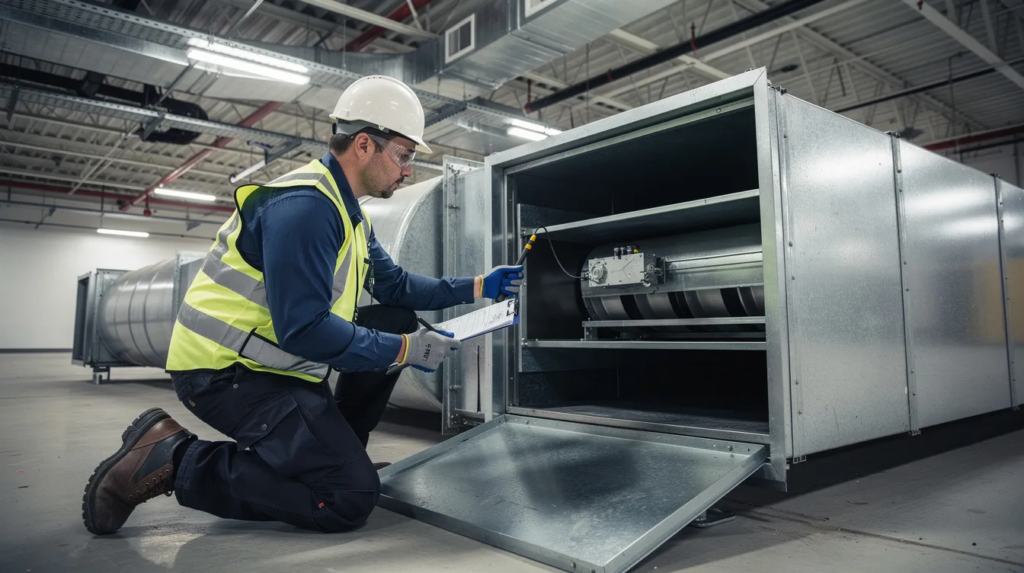
A useful inspection programme begins with an accurate asset register. Each damper should have a unique reference and a recorded location so it can be found, accessed and matched to its test history. Professional fire damper testing should be planned so the competent person can inspect the full blade path, the access panels and the relevant part of the building’s ductwork. This supports regular inspection and detailed records without confusing a test result with full compliance across the premises.
Visual inspection
Before operating the damper, the competent person should check matters such as:
- the damper type and identification;
- the condition and suitability of the access panel;
- visible damage, corrosion, dust or debris;
- obstructions within the blade path;
- the fusible link, actuator or release mechanism, as applicable;
- the surrounding installation and any visible concerns affecting the compartment line.
Access panels matter because the whole damper needs to be inspected and operated safely. Where a damper is inaccessible, that limitation should be recorded and suitable access arranged rather than treating the unit as having passed.
Functional drop test
A fire damper drop test releases or activates the damper so the inspector can confirm that it moves through its intended travel and closes. The damper is then reset in accordance with the appropriate procedure.
The exact method depends on the product. A mechanical fire damper and a motorised fire and smoke damper should not be treated as identical. Manufacturer information and the building’s cause-and-effect arrangements may need to be reviewed before testing.
Recording the result
The report should clearly identify whether each damper passed, failed or could not be tested. It should record defects and limitations without implying that an inaccessible or partially inspected damper is satisfactory.
Fire damper maintenance requirements after testing
Testing establishes condition at a point in time. Maintenance and remedial work address the issues that could prevent reliable operation.
Routine fire damper maintenance requirements may include cleaning accessible components, removing obstructions and carrying out manufacturer-approved adjustments. If the test identifies damage, a defective mechanism, unsuitable access or a concern with the installation, repair or further investigation may be required.
A failed test should lead to a clear action, priority and completion record. The appropriate response depends on the defect and the building’s risk assessment. Testing should not be presented as complete while identified remedial works remain unresolved.
Through our fire damper maintenance service, we inspect accessible dampers, carry out drop tests and provide photographic reporting. We can identify faulty components and the remedial work needed, keeping the testing record separate from any subsequent repair activity.
What should a fire damper test report contain?
A clear report helps the responsible person understand what was tested and what must happen next. It should normally include:
- a unique damper reference and precise location;
- the damper type and relevant operating mechanism;
- the inspection and test date;
- the test method and result;
- photographs showing the damper and its condition;
- details of defects, access restrictions or other limitations;
- recommended maintenance or remedial action;
- the name of the competent person or organisation completing the work.
Records should be retained with the premises’ fire safety information and used to plan the next inspection. They should also show when defects were addressed, rather than ending with the initial failure report.
Common reasons fire dampers fail a test
A fire damper can fail for more than one reason. Common findings include debris in the blade path, corrosion, damaged blades, a seized mechanism, a missing or unsuitable access panel and defects affecting the release or reset process.
Building work can also create problems. New services may obstruct access, ductwork alterations may affect operation, or work around the penetration may disturb the surrounding fire-stopping. These issues need to be assessed in context because the damper is only one part of the compartment boundary.
Regular testing and maintenance make it easier to identify changes before records are lost or faults accumulate. A consistent asset register is particularly useful on sites with many dampers or phased refurbishment work.
Planning a compliant testing programme
Start by checking the current fire risk assessment, fire strategy, as-built drawings, operation and maintenance information and previous damper reports. Compare these records with the dampers that can actually be located on site.
The programme should then define:
- which dampers are included;
- the planned inspection interval;
- who is responsible for arranging access and testing;
- the evidence required from the competent person;
- how failures and inaccessible dampers will be prioritised;
- how completed remedial works will be recorded.
Fire damper testing should sit within the wider maintenance arrangements for the building’s fire safety systems. It should not be treated as an isolated certificate-gathering exercise.
Arrange fire damper testing and maintenance
We help responsible persons and facilities teams inspect, test and maintain fire and smoke dampers. Our work can include locating accessible units, visual inspection, fire damper drop testing, photographic evidence and reporting, and identifying repairs or remedial works. These maintenance services support a documented testing and maintenance programme for the building.
If you need to review your current fire damper inspection frequency or address gaps in previous records, contact us to discuss the premises and the scope required.
Frequently asked questions
Is fire damper testing a legal requirement?
The Fire Safety Order requires relevant fire precautions to be maintained in efficient working order and good repair. It does not name a universal annual damper test, but functional testing is a recognised way to support that maintenance duty and assess whether dampers operate correctly.
What are the testing requirements for fire dampers?
A suitable programme should identify every damper, provide safe access, include visual and functional checks, record the result and ensure defects are addressed. The method should follow the damper type, manufacturer’s information, fire strategy and risk assessment.
How often should fire dampers be tested?
BS 9999 recommends testing by a competent person at intervals not exceeding one year. More frequent testing may be appropriate where environmental conditions, previous defects or the fire risk assessment indicate a greater risk.
What is a drop test on a fire damper?
A drop test releases or activates the damper so its movement and closure can be observed. The damper is then inspected and reset using the appropriate procedure. The test helps identify obstructions, damage or mechanical faults.
What happens if a fire damper fails its test?
The defect and its location should be recorded, assessed and assigned suitable remedial action. Repair, replacement, improved access or further investigation may be necessary. Completion of the work and any retest should be added to the damper’s record.
Enquiry

Let’s talk or fill in our enquiry form today
Have you found what your looking for? Or simply require more information? Don’t hesitate to get in touch today or fill in our enquiry form and we can arrange a call back.
Get in touch