What You Need To Know About Industrial Fire Curtains
In industrial environments, a fire is rarely an isolated problem. Large open spaces, production lines, storage areas, electrical equipment, flammable materials and the constant movement of people and vehicles can allow fire and smoke to spread rapidly. For this reason, fire safety in factories, warehouses and commercial premises should not rely on a single fire protection measure.
Industrial fire curtains are an important part of this strategy, enhancing fire safety without disrupting daily operations. They help create a temporary fire barrier, support smoke control, protect escape routes, limit the spread of fire and smoke, and give building occupants more time to evacuate safely.
What is a Fire Curtain?
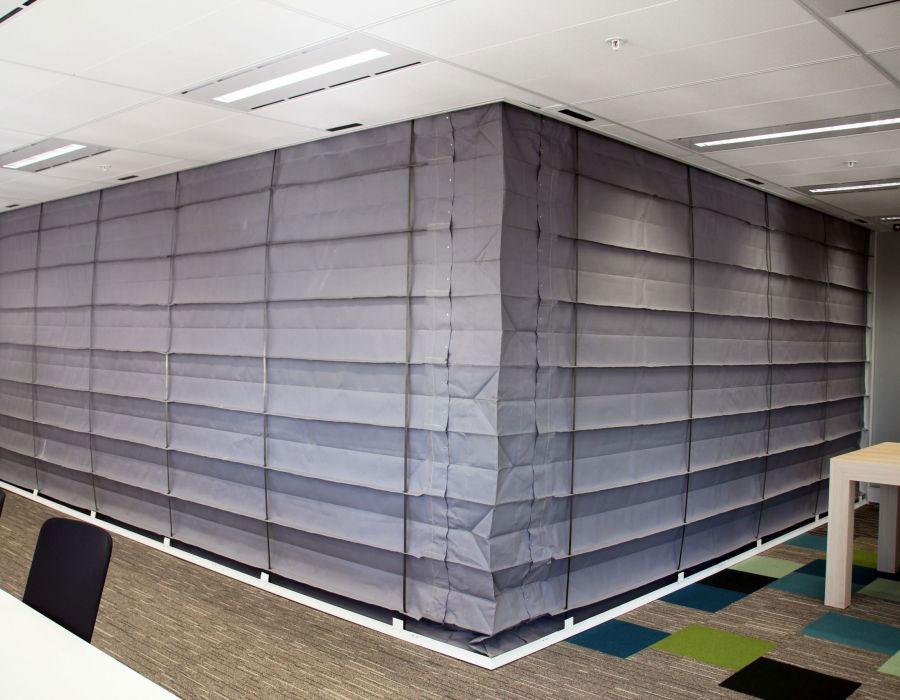
A fire curtain is a specialised fire-resistant barrier designed to lower automatically in the event of a fire. Unlike a standard curtain, it is made from fire-resistant materials capable of withstanding high temperatures for a specified period, helping to contain flames, heat and smoke.
Under normal conditions, the curtain is retracted into a box installed in the ceiling, in a structural opening or above a passageway. When the fire alarm system is triggered, the deployment mechanism releases the curtain, which descends to its designated position to create a physical barrier. This barrier can help separate hazardous areas, protect escape routes or contain the fire within a specific compartment.
In industrial buildings, this is particularly useful because it is not always possible to construct fixed walls or install fire doors at all necessary points. Many operations require open spaces for the movement of stock, machinery, forklifts, people and production lines. The fire curtain allows this flexibility in building design to be maintained without compromising the need for fire compartmentation.
How Industrial Fire Curtains Work
Industrial fire curtains are active fire curtains. This means that they form part of an active fire protection system, usually connected to the building’s fire alarm system and the wider building’s fire protection system. The system typically includes the curtain itself, a top box, side guides, a motor or lowering mechanism, a control panel, and integration with alarms or other building systems.
Depending on the opening and the fire safety strategy, the specification may involve automatic fire curtains, smoke curtains or concertina fire curtains. The correct type should be selected according to the required fire resistance, smoke control needs, available ceiling space and the way the building is used.
When a fire is detected, the system sends a signal to the curtain. From there, it descends in a controlled manner until it closes the opening specified in the design. Depending on the specification, it can be used to protect a passageway, divide a large internal space, isolate a storage area or help maintain a safer escape route.
The most important point is that the curtain only works correctly when it has been properly specified, installed and maintained. Actual performance depends on the compatibility between the product, the building structure, the fire alarm system, the evacuation strategy and the operational risk of the site.
Why Fire Curtains Matter in Industrial Building Design
In industrial facilities, building design is often driven by productivity. Large spans, high ceilings, wide corridors, open-plan areas and quick access between sections are essential for day-to-day operations. The problem is that these very same features can facilitate the rapid spread of fire and smoke.
Fire curtains provide a discreet solution to this conflict. They remain hidden when not in use and only appear when needed. This allows the building to maintain its operational functionality without compromising on fire protection.
They can be particularly useful in manufacturing plants, warehouses, loading bays, production areas, packaging zones, mezzanines, service corridors and areas where there is a separation between offices and industrial operations. In high risk areas with highly flammable materials, critical equipment or high stock volumes, the curtain can help limit damage and reduce the risk of fire spreading to other areas.
The better the building is divided into fire compartments, the lower the likelihood of a fire quickly compromising the entire space. In the year ending December 2025, Fire and Rescue Services in England attended 642,264 incidents. Of these, 175,918 were fires, a 29% increase compared with the previous year. A further 40,350 building fires were recorded during the same period.
Fire Curtains, Fire Doors and Fire Barriers: What Is the Difference?
Fire doors, fire shutters, fire curtains and other fire barriers are not the same thing, although they can all form part of the same strategy.
Fire Doors
Fire doors are fire-resistant doors used to protect passageways and help maintain fire compartments. They are essential in many escape routes and circulation areas.
Fire Barriers
Fire barriers can include walls, floors, fire doors, seals, shutters and curtains. The term is broader and describes any element designed to withstand fire and resist the passage of fire, heat or smoke for a defined period. In practice, fire barriers must be specified as part of the building’s fire safety strategy, taking account of fire resistance, compartmentation, escape routes and the relevant safety standards.
Fire Curtains
Fire curtains are different because they remain retracted until activated, and there are several types used for different opening and operational needs, including vertical drop, smoke and concertina fire curtains. They are particularly useful where a permanent fire door or wall would be impractical for the day-to-day use of the building, such as large access routes, production areas, loading bays or wide internal openings. However, this does not mean that they automatically replace fire doors or other measures.
The choice must be made based on the fire risk assessment, the fire safety strategy and the requirements applicable to the building. The correct approach is always to treat the curtain as part of a system, not as a stand-alone solution.
Protecting Escape Routes and Building Occupants
Most people think of flames first, but smoke and toxic gases also pose a critical risk in fires. In industrial environments, the presence of plastics, packaging, chemicals, wood, fuels or electrical components can make smoke even more dangerous.
Fire curtains help control this risk by limiting the movement of fire and smoke between areas. When correctly specified and installed, they can reduce the movement of heat, smoke and toxic gases, helping to keep evacuation routes clearer for longer. Where smoke curtains are part of the smoke control strategy, they can also support protection around lift lobbies, staircase entrances and large open atria, where smoke may otherwise move quickly between floors.
This type of containment also helps emergency teams. If the fire is confined to a specific area, the response can be more targeted. The aim is not only to protect the building, but to buy time. That is, time to evacuate, time to activate other fire protection systems, and time to minimise structural and operational damage.
Why Correct Specification Matters
The installation of a fire curtain should not be treated as a simple matter of fitting a product. Before installation, it is necessary to understand the risk, the structure, the opening to be protected, the available height, any obstructions on the ceiling, and the presence of cables, ducts, beams, sprinklers, lighting, signage and nearby equipment.
It is also essential to check how the curtain will be activated. Integration with the fire alarm system must be reliable, testable and compatible with the building’s actual use. A curtain installed in the wrong position, with obstructions in the drop zone or without adequate access for maintenance, can compromise its effectiveness when it matters most.
Therefore, the specification must consider not only the curtain’s fire resistance, but also its role in the overall strategy for fire compartmentation, smoke control, compliance with relevant safety standards and safer evacuation.
Maintenance and Testing of Active Fire Curtains
A fire curtain only provides enhanced safety if it is in working order. Over time, the fabric can become worn, guides can become misaligned, motors can fail, obstacles can block the descent, and changes to the layout can interfere with operation.
Fire curtains are an essential part of a building’s fire protection system, and regular maintenance is essential to keep them operational, compliant and ready to perform in an emergency. Maintenance should cover the critical aspects of performance, including testing the deployment mechanism, inspecting the fabric for damage, checking guides, motors and control panels, and correcting faults promptly so the curtain descends and retracts correctly.
In the UK, active fire curtains should be specified, installed and maintained with reference to the BS 8524 series, including BS 8524-1:2025 for active fire curtain barrier assemblies and BS 8524-2:2025 for application, installation and maintenance. Product performance, installation quality and ongoing testing should be supported by appropriate documentation and, where relevant, evidence of rigorous testing or third-party certification.
In industrial environments, maintenance is even more important. Forklift traffic, the movement of pallets, the installation of new equipment and frequent changes to the layout can create problems that did not exist at the time of installation. Maintenance is not just a compliance formality; it is what keeps the system functional and supports duties under the Regulatory Reform (Fire Safety) Order 2005, including keeping fire risk assessments up to date and maintaining appropriate fire precautions.
Common Issues That Affect Effectiveness
The most common problems do not necessarily lie with the product, but with the way the building is used. Drop-down areas blocked by stock, damaged guides, lack of testing, uncoordinated electrical alterations, poorly integrated sensors, dust, mechanical impact and incomplete documentation can all reduce the system’s reliability. Whenever the layout changes, a production line is altered or an opening is modified, the fire safety and compartmentation strategy should be reviewed.
Why Choose LJM Fire Solutions?
LJM Fire Solutions installs, maintains and repairs fire and smoke curtains across Newcastle and the UK. The company’s technicians follow manufacturers’ guidelines and focus on quality, compliance and tailored fire protection solutions designed around the specific fire safety needs of each building.
For industrial and commercial premises, this approach is essential. Every site has its own risks. Different materials, shifts, processes, layouts, escape routes and operational continuity requirements. A standard solution is rarely sufficient.
LJM also offers installation services for mechanical fire protection systems for commercial and industrial premises across the UK, with installations tailored to the building’s fire risk and in compliance with current fire safety regulations. In addition to installation, the company offers maintenance and repair of fire curtains, including support to restore the system’s proper performance in the event of faults or damage.
For an industrial environment, choosing a supplier with practical experience in installation, inspection, maintenance, testing and repair helps reduce risk, maintain compliance and protect people, assets and operations.
Summary
Industrial fire curtains are important safety devices for industrial, commercial and public buildings. As part of a building’s fire protection system, active fire curtains help control the spread of fire and smoke, protect escape routes, support fire compartmentation and contribute to a safer evacuation.
Their main advantage is combining protection with flexibility. Rather than relying solely on permanent walls, shutters or fire doors, the curtain remains retracted until it is needed. This allows the building design and day-to-day operation to be preserved without compromising the fire protection strategy.
However, their effectiveness depends on correct specification, professional installation and regular maintenance. A fire curtain must be aligned with the fire risk assessment, with the applicable UK requirements and with the building’s overall strategy.
Frequently asked questions
What is a fire curtain?
A fire curtain is a fire-resistant barrier that descends automatically in the event of a fire to help contain flames, heat and smoke. In industrial buildings, it can be used to compartmentalise large areas, protect openings and support escape routes.
Do fire curtains replace fire doors?
Not always. Fire curtains and fire doors have different functions. In some cases, a fire curtain may be specified as an alternative for an opening, but this depends on the design, the fire risk assessment, the evacuation strategy and the applicable compliance requirements.
Are fire curtains suitable for warehouses and manufacturing plants?
Yes. Warehouses and manufacturing plants often have open spaces, large spans and areas with a high fire load. Fire curtains can help divide these spaces into fire compartments, protect key openings and limit the spread of fire and smoke.
How often should fire curtains be maintained?
The frequency should follow the manufacturer’s guidelines, the risk assessment and the requirements applicable to the building. Fire curtains must be inspected and tested regularly to confirm that they descend, retract and operate correctly.
What standards apply to active fire curtains in the UK?
The main technical reference is the BS 8524 series. BS 8524-1:2025 covers the specification of active fire curtain barrier assemblies, while BS 8524-2:2025 covers application, installation and maintenance. Together, these standards support the design, manufacture, testing, installation and maintenance of automatic fire curtains used as a vital part of a building’s fire protection system.
Enquiry

Let’s talk or fill in our enquiry form today
Have you found what your looking for? Or simply require more information? Don’t hesitate to get in touch today or fill in our enquiry form and we can arrange a call back.
Get in touch