Dry Risers: What They Are And How They Work
When there is a fire in a high-rise building, time and access to water can make all the difference. A dry riser is a key part of fire safety systems, giving the fire brigade a fixed route to deliver water quickly to upper floors. Rather than forcing firefighters to carry long, heavy hoses from street level through the building, the system allows water to reach the vicinity of the fire faster and supports more effective firefighting efforts.
What Is a Dry Riser?
A dry riser system is a fixed network of pipework installed inside a building so that firefighters can access water quickly on upper floors or underground levels during a fire emergency. Under normal conditions, the pipes remain empty and are only charged with water during testing or when the fire service needs to use the system.
When firefighters arrive, they connect the fire engine to an inlet at ground level or on the ground floor, and then pump water through the system, distributing pressurised water to outlets on each floor. This means that a dry riser is not intended for everyday use by the building’s occupants, but to support the fire service at a critical moment.
In taller buildings, hotels, hospitals, residential blocks and a wide range of commercial environments, a dry riser reduces the time and effort involved in carrying heavy hoses up stairs and through corridors. This improves firefighting efforts and helps to contain the spread of fire more quickly. The faster water reaches the correct floor, the greater the chance of protecting people, rooms and the structure.
How Does a Dry Riser System Work in Practice?
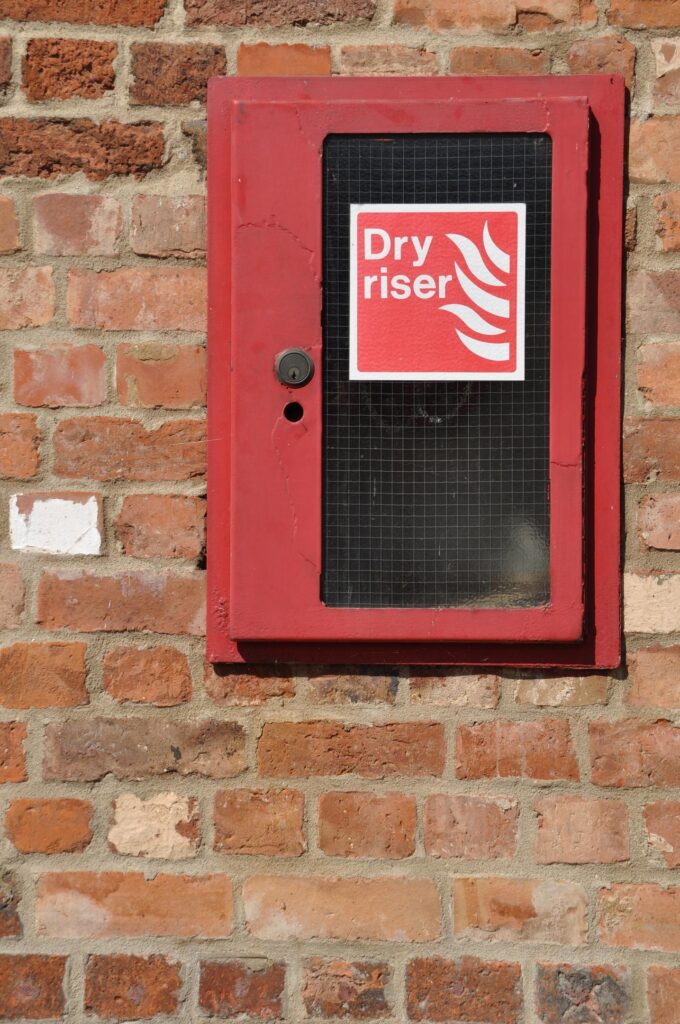
The system’s operation is relatively simple, yet highly effective. On the outside of the building, usually at ground level and adjacent to the external wall, there is an inlet valve or inlet breeching. This is where the fire brigade connects the water supply. From there, the water is pumped into the system’s main vertical pipe.
Throughout the building, on each relevant floor, there are outlet valves, usually called landing valves, positioned in protected areas such as lobbies or fire escape stairwells. This arrangement completely changes the operational response.
Instead of running a full line from the street up to the top floor, the team ascends with a shorter hose and connects to the point closest to the fire. This saves valuable time, reduces physical exertion, improves control of the operation and allows water to reach the location where it is actually needed more efficiently.
This is why dry risers consist of much more than just pipes. They form part of the infrastructure, providing the fire service with access to the building. Another important point is the difference between a dry system and a wet system.
The main difference lies in the state of the system when not in use. A dry riser remains empty until it is activated. A wet riser, on the other hand, is continuously filled with water and is supplied by tanks and pumps within the building. In Approved Document B, a wet system is explicitly required when the building has a storey more than 50 metres above the fire service vehicle access level.
Main Components of a Dry Riser System
Although the concept is simple, a dry riser system relies on several components working together. The first is the inlet at the fire service access level. This is where the water pumped by the fire engine enters the system. Next comes the main riser, made of steel, which runs vertically through the building.
Finally, there are the landing valves or outlets on each floor, allowing firefighters to connect near the source of the fire. Approved Document B also stipulates that, where there is a firefighting shaft, the fire main outlets must be located within the protected stairway or protected lobby.
The system includes inlets on the ground floor and outlets on each subsequent floor, precisely to allow water to be quickly delivered to higher levels during emergencies. LJM Fire emphasises the importance of landing valves on each floor and a dry riser inlet on the exterior of the building.
The system’s performance does not depend solely on the initial installation. The location of the cabinets, the integrity of the valves, the condition of the seals, unobstructed access to connection points and the condition of the pipework directly influence the response during a real incident. A dry riser only fulfils its role when it is clearly identified, accessible and properly maintained.
Dry Riser vs Wet Riser: What Is The Difference
A dry riser remains empty and relies on an external water supply in the event of a fire. A wet riser, on the other hand, remains filled with water and is supplied by pumps and tanks within the building, often with a pump room to help maintain pressure in taller buildings. In practical terms, a wet riser offers immediate availability of water, whilst a dry riser relies on the fire service connecting it when they arrive on site.
This does not mean that one is better in every scenario. The key is suitability. In very tall buildings, the immediate and constant availability of water becomes critical. In other cases where a fire main is provided, the design may opt for a dry or wet system, depending on the building’s strategy, fire brigade access, layout and the safety engineering adopted.
The simplest way to summarise is that a dry riser is a water distribution system ready to be charged; a wet riser is a system that is always charged. Both support firefighting. The difference lies in how the water supply reaches the system and in the type of building where each solution makes the most sense.
When Is a Dry Riser Required?
In England, buildings with a storey more than 18 metres above the fire service access level must have one or more firefighting shafts. The same principle applies where there are storeys more than 10 metres below that access level.
As buildings with firefighting shafts must have fire mains, dry risers are a common solution in high-rise buildings and on certain underground levels. Under Approved Document B and the relevant building regulations, buildings with storeys over 50 m require wet fire mains instead.
There is no single rule that applies in every case, but dry risers are typically used where a fire main is required below the height at which wet systems become mandatory. Different parts of the UK may also apply their own fire safety requirements.
Maintenance, Testing and Legal Requirements
Installing a dry riser is only part of the job. The system requires regular maintenance and testing to ensure it is ready when needed and that all legal requirements are met. The responsible person may be the employer, the property owner, the landlord, the occupier or someone in control of the premises, such as a facilities manager or managing agent.
This person must put in place and maintain appropriate fire safety measures. Furthermore, Regulation 17 of the Regulatory Reform (Fire Safety) Order 2005 requires installations, equipment and appliances relating to fire protection to be kept in an efficient condition, in effective working order and in good repair.
At a technical level, the key reference remains BS 9990:2015, which is still listed by the BSI as ‘Current, Under Review’ and is one of the main British Standards covering best practice for the design, installation, testing and maintenance of non-automatic fire-fighting systems, including wet and dry fire-fighting mains.
It remains the main technical reference for those who design, install and maintain these systems. BS 9990:2015 recommends six-monthly visual inspections of valves, cabinets, locks and seals, together with annual pressure testing at the system’s operating pressure. In practice, dry risers should be visually inspected every six months and subject to hydraulic pressure testing every 12 months or after use by the fire brigade.
The legal obligation is to maintain equipment properly under the Fire Safety Order, whilst BS 9990 provides the practical guidance on inspection and testing followed across the industry. The Fire Safety (England) Regulations 2022, in force since 23 January 2023, also require monthly checks of certain items of essential fire-fighting equipment in some high-rise residential buildings.
The official fact sheet makes clear that this includes inlets for dry-rising mains and outlets for dry-rising mains. This makes regular inspection, prompt identification of damage and rapid rectification of faults even more important for those responsible for this type of building.
Why Choose LJM Fire?
LJM Fire specialises in fire protection solutions, with over 40 years of experience, work carried out by its own engineers and a focus on complying with current codes of practice and legislative requirements. The company provides installation, maintenance and repair services for mechanical fire protection systems, including dry riser systems.
Dry risers are not an element that can be treated in a generic manner. Every building has its own layout, compartmentalisation strategy, fire service access pattern and operational routine.
Working with a company that understands installation, testing, repair and compliance as a single package reduces risk, improves service continuity and helps the client keep the system ready for actual use, not just approved on paper.
LJM Fire emphasises this point precisely: direct service, bespoke solutions, recommendations aligned with current standards and practical solutions to keep essential systems in operational condition. This is what transforms a supplier into a compliance and safety partner.
Conclusion
A dry riser is a fixed pipework system that remains empty until the fire service connects a water source and begins to pump the system during an emergency.
It is designed to deliver pressurised water quickly to the floors where the fire is being tackled, reducing the need to carry heavy hoses up the entire building and helping firefighters to respond more quickly and efficiently.
Dry risers are a critical part of the fire safety infrastructure in more complex buildings, especially where height or depth makes operational access more difficult. This is why solutions such as those offered by LJM Fire are so important.
Frequently asked questions
What is a dry riser?
It is a dry fire main, normally empty, which allows the fire service to pump water into the building and use it via landing valves or outlets on each floor.
How does a dry riser work?
Firefighters connect the fire engine to the inlet valve at ground level, pump water into the main riser, and then use the outlet valves on the floor closest to the fire.
What is the difference between a dry riser and a wet riser?
A dry riser remains empty until it is used. A wet riser remains filled with water and is supplied by pumps and tanks within the building, providing immediate water availability when needed.
When is a dry riser usually required?
It is common in buildings where a fire main is required because of the height or depth of the building, particularly where the top storey is more than 18 metres above the fire service access level.
Who is responsible for maintenance?
The responsible person, who may be the owner, landlord, occupier, managing agent, or facilities manager, must ensure adequate fire safety measures are in place and keep the systems in good working order.
How often should the system be tested?
The legal obligation is to keep the equipment effective and in good working order. As a technical reference, BS 9990:2015 recommends six-monthly visual inspections and annual pressure testing, with hydraulic pressure testing also carried out after use by the fire brigade.
Are there additional requirements for high-rise residential buildings?
Yes. In England, the Fire Safety (England) Regulations 2022 require monthly checks of certain items of essential fire-fighting equipment in high-rise residential buildings, including the inlets and outlets of dry-rising mains.
Why is regular maintenance so important?
Because the system only helps to save lives and protect property if it is accessible, clearly identified, and fully operational at the time of an emergency. Regular maintenance and testing help to ensure that valves, cabinets, seals, and access points do not compromise the fire service’s response during a fire emergency.
Enquiry

Let’s talk or fill in our enquiry form today
Have you found what your looking for? Or simply require more information? Don’t hesitate to get in touch today or fill in our enquiry form and we can arrange a call back.
Get in touch